
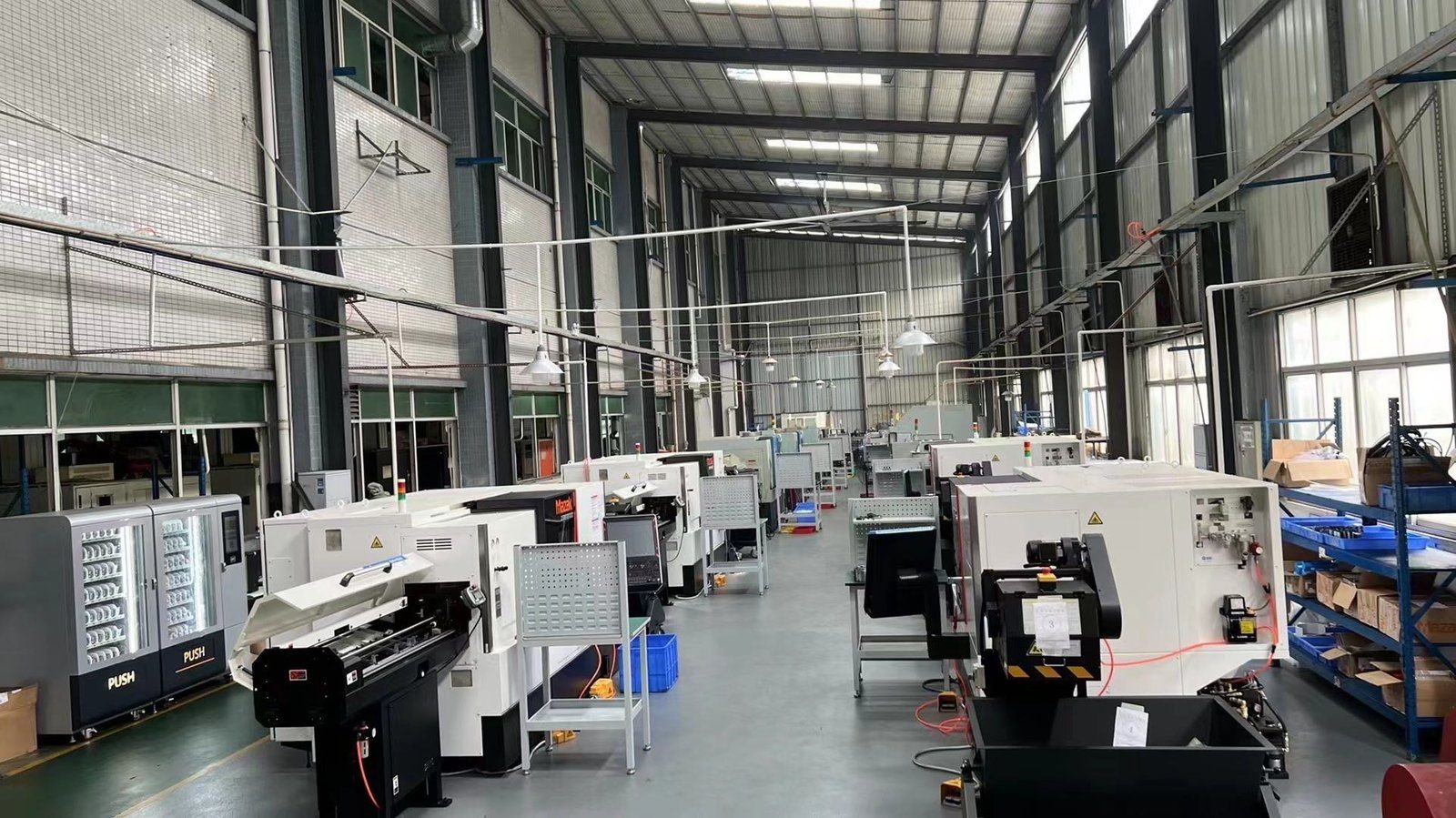
- Dongguan Zhuohang Ltd (Registration No. 91441900MA4UWT6X39), operating as Zhuohang Precision Machining Factory, established 2005; 100+ CNC machines; certified to ISO 9001:2015, IATF 16949:2016 (excluding clause 8.3 product design) and ISO 14001:2015; holding ±0.003 mm CNC milling / ±0.002 mm CNC turning tolerance.
- CNC Machining removes material from a solid billet; casting pours molten metal into a mould.
- CNC Machining wins on tolerance, material properties and low-volume flexibility; casting wins on per-part cost at high volume and on hollow/complex shapes.
- The cost curves cross somewhere in the low thousands of parts — batch size, not the part itself, usually decides.
How the two processes make the part
CNC Machining is subtractive: a billet of wrought metal is held in a vice or fixture and cut to shape with rotating or moving tools. Every feature is defined directly by the toolpath, so the first article can ship in days with no part-specific tooling and design changes cost nothing but a CAD edit. Casting is formative: molten alloy is poured or forced into a mould that reproduces the part shape, including internal cavities that CNC Machining cannot reach. The mould is the cost and the lead-time driver, and changing the design later means changing the tool.
Side-by-side comparison
| Factor | CNC machining | Casting |
|---|---|---|
| Tooling | CAD/CAM + standard cutters; near-zero part-specific tooling, first article in 1–3 days | Pattern + mould or steel die; die casting tooling often $5k–$100k+, lead time weeks |
| Lead time (first article) | 1–3 days from released CAD | 2–8 weeks including tool making |
| Economic batch | 1-off to low-volume; no amortisation hurdle | 1,000–50,000+ parts where tooling cost is spread across the run |
| Tolerance | ±0.003–0.05 mm achievable | Sand ±0.5 mm; die cast ±0.1–0.2 mm |
| Surface finish | Machined Ra 0.4–1.6 µm directly | As-cast 3.2–12.6 µm; usually requires machining to seal surfaces |
| Materials | Any wrought stock: 6061/7075, steels, stainless, titanium, Inconel | Castable alloys only: A380/ZL aluminium, cast iron, zinc, magnesium |
| Wall thickness | No absolute minimum (thin features become fragile) | Die cast ~3 mm min; sand cast thicker |
| Design freedom | Limited to cutter-accessible geometry; deep cavities need 5-axis/EDM | Hollow sections, internal cores and complex shapes come naturally |
| Material structure | Wrought, dense, isotropic; superior fatigue strength | As-cast grain with possible shrinkage porosity and lower fatigue life |
| Design change cost | Edit CAD and re-run — near zero | New or modified tooling — expensive |
| Post-processing | Deburr, anodise, plate, heat treat | Trim, blast, frequently CNC machining of mating faces |
| Typical applications | Brackets, housings, fixtures, precision components | Engine blocks, pump bodies, large enclosures |
Where CNC Machining wins, where casting wins
CNC Machining is the stronger choice when you need tight tolerances (±0.003–0.05 mm), superior mechanical properties from wrought stock, a handful of prototypes through to a few hundred production parts, or a material that is not readily castable (titanium, Inconel, hardened steel). It is also the natural finishing step for castings — most die-cast housings are machined on mating faces anyway, because the as-cast surface cannot hold a seal or a bearing bore to the needed accuracy.
Casting is the stronger choice for runs of thousands where the tooling can be amortised, for parts with hollow sections or internal cores, and for very large components where a solid billet would be uneconomic to buy and to cut. Expect to machine the surfaces that must seal or locate, and to budget for non-destructive testing on safety-critical castings.
Material structure and properties
Because CNC Machining starts from wrought stock, the grain is dense and effectively isotropic, giving reliable fatigue and impact performance that you can predict from the mill certificate. Cast parts solidify from the melt: the grain is coarser and shrinkage porosity or cold shuts can appear, so cast alloys are typically specified with a property margin and verified by X-ray or magnetic-particle inspection on load-bearing items. For a part where failure is not an option, the predictability of wrought stock is a real argument for CNC Machining.
Process-selection checklist
- Need <100 parts or a 1-off prototype? → CNC Machining.
- Need ±0.01 mm or better, or titanium/Inconel? → CNC Machining.
- Need 5,000+ identical parts with internal cavities? → evaluate casting.
- Cast part must carry load or seal a face? → plan for secondary CNC Machining finishing.
- Wall sections under 3 mm at high volume? → die casting leads.
Post-processing
CNC Machining parts need deburring and then the specified surface treatment (anodise, passivate, plate, paint). Cast parts need gate/flash removal, shot blasting and frequently CNC machining of the datum and sealing faces; impregnation may be required to stop porous leak paths, and cosmetic surfaces may need bespoke finishing.
Frequently Asked Questions
When should I choose CNC Machining instead of casting?
In short, Choose CNC Machining for low to medium volume, tight tolerance, difficult-to-cast materials, or any part where wrought mechanical properties matter. Choose casting when the tooling can be spread across a very large run or the geometry is hollow and complex.
What tolerance can CNC Machining hold versus casting?
CNC Machining routinely holds ±0.003–0.05 mm. Sand casting is around ±0.5 mm and die casting ±0.1–0.2 mm; both usually need machining on functional surfaces.
Is casting cheaper than CNC Machining?
Per part, yes — but only above the volume where the mould cost is amortised (often a few thousand parts). Below that, CNC Machining is cheaper because there is no tooling to recover.
Can cast parts be machined afterwards?
Yes. It is common to cast a near-net shape and finish the critical faces, bores and threads by CNC Machining to reach the required tolerance and surface.
Cost crossover in practice
When you are choosing, the question is rarely which process is "better" and almost always about batch size. As a working rule for a part of moderate complexity: CNC Machining costs a few tens of dollars in machine time per piece with no upfront tooling, so 100 parts might total a few thousand dollars. Casting needs tooling in the low five figures, so the same 100 parts would be far more expensive once the tool is paid for — but at 10,000 parts the per-piece tooling share falls to cents and the formative process wins decisively. The practical crossover for most components lands between 1,000 and 5,000 pieces; above it, amortised tooling dominates, below it, CNC Machining is cheaper and far more flexible. Always quote both before you commit, because material yield, secondary operations and scrap rate shift the exact break-even for your part.
Design-for-manufacturing tips
- Keep functional tolerances at ±0.02–0.05 mm where cnc lathe machining is used; reserve ±0.003 mm (milling) / ±0.002 mm (turning) for critical datums only — every tighter band adds cost.
- Design for standard stock sizes and minimise deep, narrow cavities that need long-reach or 5-axis tooling.
- If volume will rise, design the part so it can later move to casting without changing the interface — locate on the same datums.
- Specify surface finish only where it matters; machined finish is cheap, plating and anodising are the cost drivers.
What this shop actually runs
Capability evidence should come as specifics, not slogans. Behind this guide is a 6,800 m2 plant in Dongguan, China running 100+ CNC machines with 100+ staff. The machine list by category:
- 5-axis machining centres (10+) - Mazak VARIAXIS I-600 (510/910/510 mm travel, 12,000 rpm, 22 kW, 71.6 N·m, 30-tool BT40) and Mazak INTEGREX I-250H S (B-axis 0.0001°, 24 kW, 124 N·m, 38-tool HSK-A63). Intended for compound-angle parts, single-setup multi-face prismatic work, and aerospace fittings where datum transfer loss is unacceptable.
- 3-axis / 4-axis machining centres (50+) - Brother SPEEDIO S500Z2N / S700Z2N (10,000 rpm, 14/21-tool ATC, 0.7 s tool-to-tool, Z-axis 2.2 G) and Mazak VCE-430A L / VCE-570C L (10,000 rpm, 118 N·m, 24-tool ATC). Intended for prismatic parts, plates, brackets, housings.
- Swiss-type turning centres (10+) - Citizen Cincom A20-3F7 (Φ20 mm, 10,000 rpm), TSUGAMI B0206-III / B0205-III (Φ20 mm, 0.1 µm), STAR SR-32JII / SR-32J Type N (Φ32 mm, 8,000 rpm). Intended for long, slender rotational parts at ±0.002 mm.
- CNC turning centres (20+) - HEADMAN T70M/1250 (720 mm swing, 117 mm bore, 3,000 rpm, BMT75 12-station turret). Intended for shafts, bushings, flanges up to ±0.002 mm.
- Wire EDM (5+) - Sodick AQ535L (550/350/300 mm travel, ±20° taper, 800 kg workpiece). Intended for hardened tool steel, internal splines, sharp internal corners that milling cannot reach.
- Inspection: Hexagon CMM + 20+ gauges - Hexagon CMM for coordinate measurement, plus vision system, profilometer, hardness tester, coating thickness gauge, XRF for material verification. The 10:1 rule (gauge 10x more accurate than the band) is applied to every feature.
- Machine highlights - VARIAXIS I-600: one-setup multi-face 5-axis + MAZA-CHECK auto-calibration; INTEGREX I-250H S: DONE-IN-ONE mill-turn, B-axis 0.0001° + Ai thermal shield; SPEEDIO S500Z2N / S700Z2N: Z-axis 2.2 G + 0.7 s ATC; Swiss-type: guide-bush switchable + 0.1 µm resolution.
Tolerance: ±0.003 mm CNC milling / ±0.002 mm CNC turning / ±0.002 mm grinding and wire EDM. Capability: Ppk >= 1.67 initial on key characteristics, Cpk >= 1.33 ongoing.
Certificates: ISO 9001:2015 (116024/A/0001/UK/En), IATF 16949:2016 (131941/A/0001/SM/En, with design clause 8.3 excluded, stated openly) and ISO 14001:2015 (116024/B/0001/UK/En), issued to Dongguan Zhuohang Ltd, registration 91441900MA4UWT6X39, founded 2005.
Where we ship: Austria, Belgium, the Czech Republic, Denmark, France, Germany, Greece, Hungary, Ireland, Italy, the Netherlands, Spain, Sweden and the United Kingdom in Europe; Brazil, Canada, Mexico and the United States in the Americas; China, Israel, Japan, Singapore and Sri Lanka in Asia; Australia and New Zealand in Oceania; and South Africa in Africa — plus other countries and regions worldwide, shipped from our base in Dongguan, China.
Contact: Felipe Iglesias, [email protected], +86 13126536955.
Continue reading: 3 Axis CNC Lathe Machining · 4 Axis CNC Lathe Machining · 5 Axis CNC Lathe Machining
Standards referenced on this page
- ASTM A484/A484M-24 — Standard Specification for General Requirements for Stainless Steel Bars, Billets, and Forgings
- ASTM B348/B348M-21 — Standard Specification for Titanium and Titanium Alloy Bars and Billets
- ISO 9001 — Quality management systems — Requirements