
- Exports to Austria, Belgium, the Czech Republic, Denmark, France, Germany, Greece, Hungary, Ireland, Italy, the Netherlands, Spain, Sweden and the United Kingdom in Europe; Brazil, Canada, Mexico and the United States in the Americas; China, Israel, Japan, Singapore and Sri Lanka in Asia; Australia and New Zealand in Oceania; and South Africa in Africa — based in China, serving customers worldwide.
- Dongguan Zhuohang Ltd (Registration No. 91441900MA4UWT6X39), operating as Zhuohang Precision Machining Factory, established 2005.
- Titanium: Titanium cuts at a low speed not because it is hard but because it is a poor conductor and chemically reactive at cutting temperature.
- Grades in regular use: C110 ETP for conductivity, C101 OFHC for vacuum service, C145 tellurium copper for free-machining, C172 beryllium copper for strength.
- Incoming stock is verified against the mill certificate before it is cut.
On a lathe, chip control and workpiece rigidity decide the outcome more than any single number. These notes are written for you specifying a turned copper part, so you can read a turning quote against the material's real behaviour rather than against a brochure.
When copper is the right call
Reach for copper when electricity or heat has to move with the least resistance. C110 at roughly 100 percent IACS is the benchmark conductor, and copper's thermal conductivity pulls heat out of a component faster than any commercial metal except silver. That is why it is the material of bus bars, heat sinks, cold plates, electrical contacts and EDM electrodes. If you do not actually need the conductivity, brass or aluminium will usually machine cheaper - if you specify copper "just in case", you pay for a property the part never uses.
Picking the grade
The grade follows the service. C110 for conductivity, C101/C102 oxygen-free for vacuum, C145 tellurium copper when you want to trade a little conductivity for much cleaner machining, and C172 beryllium copper only when you need its strength as well. Naming the grade on the drawing is the single biggest lever on the price and the finish, because the shop cannot machine around a ductile metal it was not told to swap for a free-cutting one.
How copper cuts
Pure copper is gummy: it builds up on the tool, throws stringy chips and work-hardens, so it is genuinely unpleasant to machine and runs slow. The shop counters it with sharp high-rake tools, coolant and lighter cuts, and where the drawing allows, moves to C145 tellurium copper, which cuts nearly as freely as brass. You do not solve this - the point is that the grade choice, not the machine, is what makes a copper part cheap or expensive to run.
Tolerance, cost and finishing
Pure copper's ductility makes a tight band cost more than it does on brass or steel, and any heavy cutting needs an intermediate anneal. Plating - tin, silver or nickel for the contact surface - is specified with the drawing. MOQ is 1 piece and lead times run roughly 3 / 7 / 30 days. Send the drawing to Felipe Iglesias at [email protected] or +86 13126536955 for a grade recommendation alongside the quote.
On the lathe, copper chip control and bar straightness decide the run; the notes below are the design rules a turning buyer should check before locking the drawing.
Design rules for copper
Copper's design rules follow from two things: it conducts, and in the pure grades it is soft and gummy. For a bus bar or heat sink, flatness and surface matter more than a tight dimensional band, so call those out explicitly. Threads in pure copper are weak - use tellurium copper C145 or a threaded insert for a load-bearing thread. If the part is formed or heavily cut, the work-hardening means an intermediate anneal belongs in the process, and the drawing should expect it rather than be surprised by it.
When copper is the right call
Reach for copper when electricity or heat has to move with the least resistance - C110 at roughly 100 percent IACS is the benchmark conductor. Trade a little conductivity for machinability with C145 tellurium copper when the part is complex, and reach for C172 beryllium copper only when you need its strength as well. If you do not actually need the conductivity, brass or aluminium will usually machine cheaper; if you specify copper "just in case", you pay for a property the part never uses.
Verifying a copper supplier
The conductivity and the oxygen content are the numbers to confirm on the mill certificate: C110 ETP against C101/C102 oxygen-free copper are different materials for different services, and the certificate says which you are getting. XRF on incoming stock verifies the composition, and the grade choice is the single biggest lever on both the price and the surface finish. Ask for the grade and the conductivity evidence with the quote, and the supplier has to prove the copper rather than name it.
Lead time and how to order copper
Copper's lead time follows the grade: tellurium copper C145 machines nearly as fast as brass, while pure C110 is slower because it is gummy, so a complex pure-copper part runs longer and costs more. Roughly 3 to 7 days for a simple part, 30 days for a full first-article package. MOQ is 1 piece, and the grade is the single biggest lever on both the price and the schedule.
The cleanest start is a STEP or IGES model plus a 2D drawing that names the grade - C110 for conductivity, C145 for machinability - along with any plating (tin, silver or nickel) and the conductivity you actually need. Send it to Felipe Iglesias at [email protected] or +86 13126536955 and ask for the grade recommendation alongside the quote, so you are not paying for oxygen-free copper when tough-pitch would do.
Every material on this floor runs through the same quality system: 100+ CNC machines including the Mazak VARIAXIS I-600 five-axis and INTEGREX I-250H S mill-turn, Hexagon CMM inspection, and certification to ISO 9001:2015, IATF 16949:2016 and ISO 14001:2015, with Ppk 1.67 or better initial and Cpk 1.33 or better in production on critical characteristics. MOQ is 1 piece, lead times run roughly 3 / 7 / 30 days, and the service area covers Austria, Belgium, the Czech Republic, Denmark, France, Germany, Greece, Hungary, Ireland, Italy, the Netherlands, Spain, Sweden and the United Kingdom in Europe; Brazil, Canada, Mexico and the United States in the Americas; China, Israel, Japan, Singapore and Sri Lanka in Asia; Australia and New Zealand in Oceania; and South Africa in Africa - based in Dongguan, serving worldwide.
Electrical and thermal performance in practice
Copper earns its keep in the numbers: a C110 bus bar carries current at roughly 100 percent IACS, and its thermal conductivity pulls heat out of a component faster than any commercial metal except silver. That is why a heat sink or a cold plate is a flatness and contact problem, not just a machining problem - the mating face has to be flat and clean or the thermal path is broken. For you, the practical points are three: specify the flatness and the surface finish on the mating face, choose C145 tellurium copper where the geometry is complex so the conductivity loss is small but the machinability gain is large, and state the plating because the plating is what keeps the contact surface from oxidising and losing the conductivity you bought the copper for.
Copper at a glance
Conductivity roughly 100 percent IACS on C110 - the benchmark conductor - with thermal conductivity among the highest of any commercial metal. Tolerance ±0.003 mm milled and ±0.002 mm turned where the grade is stable, verified on a Hexagon CMM. Grades: C110 ETP for conductivity, C101/C102 oxygen-free for vacuum, C145 tellurium for free-machining, C172 beryllium for strength. Typical parts: bus bars, heat sinks, electrical contacts, EDM electrodes and waveguides. Lead time 3 / 7 / 30 days, MOQ 1 piece, certification to ISO 9001:2015, IATF 16949:2016 and ISO 14001:2015.
Ordering copper: a buyer checklist
Before you send the RFQ, lock four things. Name the grade - C110 for conductivity, C145 for machinability, C101 oxygen-free for vacuum - because the grade is the biggest lever on the price and the finish. State the flatness and the surface finish on the mating face, because a heat sink or bus bar lives or dies on contact. Specify the plating - tin, silver or nickel - because bare copper tarnishes. And state the conductivity you actually need, so you are not paying for oxygen-free copper when tough-pitch would do. Send the model and drawing to Felipe Iglesias at [email protected] or +86 13126536955.
De-risking a first order
Start with a handful of parts to confirm the routing and the tolerance, then scale. The same machines, the same inspection bench and the same certificate numbers apply to a single piece and a production run alike, so a small first batch is the proof that a large one will hold the same numbers.
What this shop actually runs
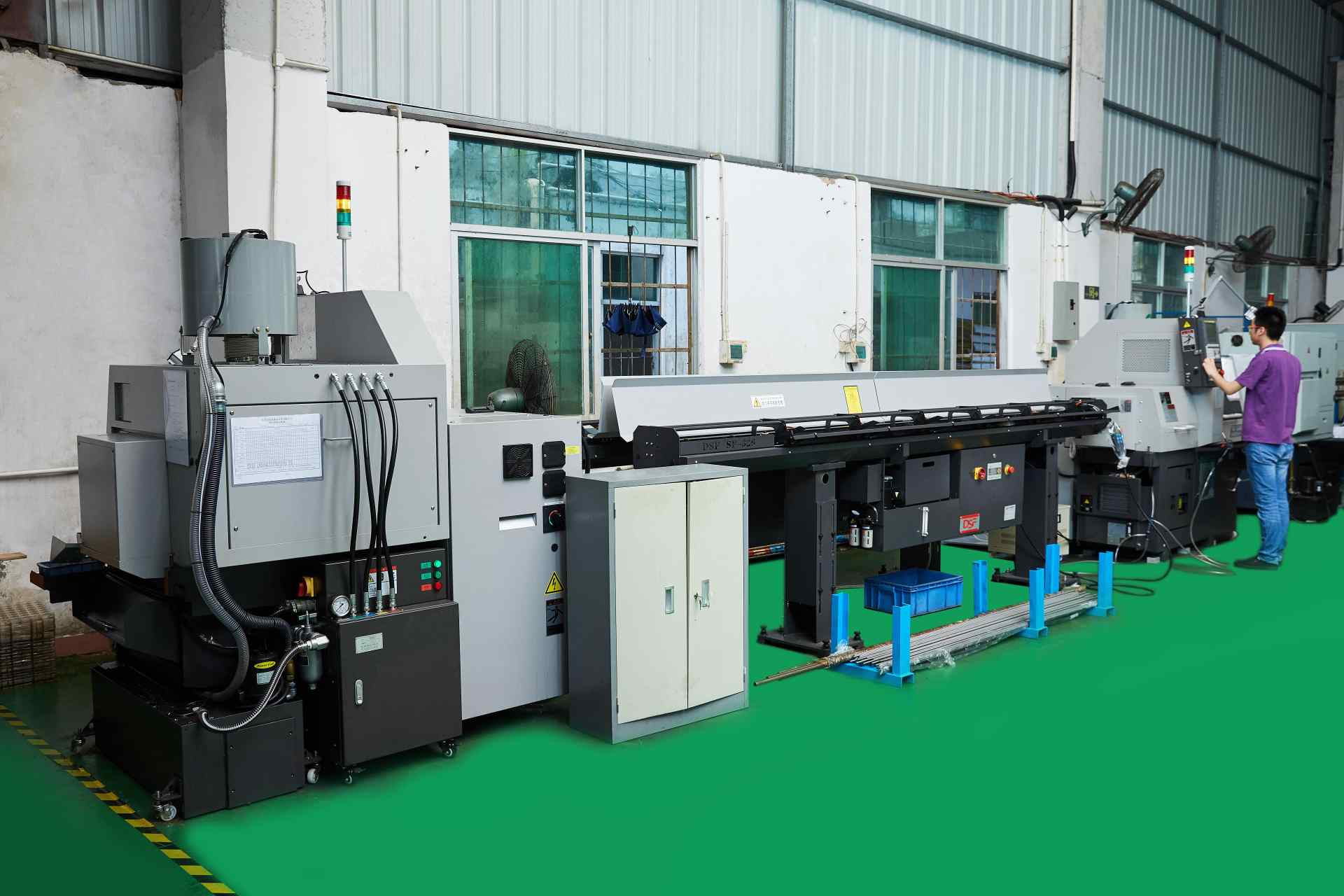
Capability evidence should come as specifics, not slogans. Behind this guide is a 6,800 m2 plant in Dongguan, China running 100+ CNC machines with 100+ staff. The machine list by category:
- 5-axis machining centres (10+) - Mazak VARIAXIS I-600 (510/910/510 mm travel, 12,000 rpm, 22 kW, 71.6 N·m, 30-tool BT40) and Mazak INTEGREX I-250H S (B-axis 0.0001°, 24 kW, 124 N·m, 38-tool HSK-A63). Intended for compound-angle parts, single-setup multi-face prismatic work, and aerospace fittings where datum transfer loss is unacceptable.
- 3-axis / 4-axis machining centres (50+) - Brother SPEEDIO S500Z2N / S700Z2N (10,000 rpm, 14/21-tool ATC, 0.7 s tool-to-tool, Z-axis 2.2 G) and Mazak VCE-430A L / VCE-570C L (10,000 rpm, 118 N·m, 24-tool ATC). Intended for prismatic parts, plates, brackets, housings.
- Swiss-type turning centres (10+) - Citizen Cincom A20-3F7 (Φ20 mm, 10,000 rpm), TSUGAMI B0206-III / B0205-III (Φ20 mm, 0.1 µm), STAR SR-32JII / SR-32J Type N (Φ32 mm, 8,000 rpm). Intended for long, slender rotational parts at ±0.002 mm.
- CNC turning centres (20+) - HEADMAN T70M/1250 (720 mm swing, 117 mm bore, 3,000 rpm, BMT75 12-station turret). Intended for shafts, bushings, flanges up to ±0.002 mm.
- Wire EDM (5+) - Sodick AQ535L (550/350/300 mm travel, ±20° taper, 800 kg workpiece). Intended for hardened tool steel, internal splines, sharp internal corners that milling cannot reach.
- Inspection: Hexagon CMM + 20+ gauges - Hexagon CMM for coordinate measurement, plus vision system, profilometer, hardness tester, coating thickness gauge, XRF for material verification. The 10:1 rule (gauge 10x more accurate than the band) is applied to every feature.
- Machine highlights - VARIAXIS I-600: one-setup multi-face 5-axis + MAZA-CHECK auto-calibration; INTEGREX I-250H S: DONE-IN-ONE mill-turn, B-axis 0.0001° + Ai thermal shield; SPEEDIO S500Z2N / S700Z2N: Z-axis 2.2 G + 0.7 s ATC; Swiss-type: guide-bush switchable + 0.1 µm resolution.
Tolerance: ±0.003 mm CNC milling / ±0.002 mm CNC turning / ±0.002 mm grinding and wire EDM. Capability: Ppk >= 1.67 initial on key characteristics, Cpk >= 1.33 ongoing.
Certificates: ISO 9001:2015 (116024/A/0001/UK/En), IATF 16949:2016 (131941/A/0001/SM/En, with design clause 8.3 excluded, stated openly) and ISO 14001:2015 (116024/B/0001/UK/En), issued to Dongguan Zhuohang Ltd, registration 91441900MA4UWT6X39, founded 2005.
Where we ship: Austria, Belgium, the Czech Republic, Denmark, France, Germany, Greece, Hungary, Ireland, Italy, the Netherlands, Spain, Sweden and the United Kingdom in Europe; Brazil, Canada, Mexico and the United States in the Americas; China, Israel, Japan, Singapore and Sri Lanka in Asia; Australia and New Zealand in Oceania; and South Africa in Africa — plus other countries and regions worldwide, shipped from our base in Dongguan, China.
Contact: Felipe Iglesias, [email protected], +86 13126536955.
Send a drawing and get a manufacturability read
Upload your model for a quote, or arrange a factory audit with [email protected] or +86 13126536955. Ask for Felipe Iglesias.
Frequently Asked Questions
Is copper a good fit for turning?
Yes. Copper turns predictably on our Mazak and Swiss lathes at ±0.002 mm, and the chip control and speed notes below are what separate a clean part from a galled one.
Are you a manufacturer or a trading company?
A manufacturer. The legal entity is Dongguan Zhuohang Ltd (Registration No. 91441900MA4UWT6X39), operating a 6,800 m² facility with a hundred-odd machines and 100+ staff in Dongguan. Factory visits are welcome.
What materials do you machine?
Aluminum, stainless steel, titanium, brass, copper, and Inconel for metals; PEEK and Delrin (POM) for plastics. Material certificates are verified on incoming stock.
Do you certify copper material?
Yes. Material certificates are supplied with the parts and incoming stock is checked against the mill certificate — composition by XRF, hardness where specified. Traceability is per heat or per batch as the certificate defines it.
How is an engineering change handled mid-production?
The change is documented against a revision, the affected parts in process are identified, and the revised drawing is confirmed in writing before work restarts. The important part is that the revision in force at any moment is a single, written one.
Can you work to ASME Y14.5 as well as ISO?
Yes. Both geometric dimensioning conventions are used. The important thing is that the drawing states which one applies, because a single symbol is not interpreted identically under the two standards.
Do you hold stock or consignment for repeat orders?
Repeat orders can run against a forecast so stock and, where the part warrants it, dedicated fixturing are held ready. This is a commercial arrangement, not a standard term, so raise it at the second order rather than the first.
Is your IATF 16949 certificate valid for design work?
No. The certificate excludes clause 8.3 (product design). The plant is certified to manufacture to your design and to run the associated process controls, not to originate product design.
Continue reading: 3 Axis CNC Lathe Machining · 4 Axis CNC Lathe Machining · 5 Axis CNC Lathe Machining
Standards referenced on this page
- ASTM A582/A582M-12 — Standard Specification for Free-Machining Stainless Steel Bars
- ASTM B348/B348M-21 — Standard Specification for Titanium and Titanium Alloy Bars and Billets
- ISO 9001 — Quality management systems — Requirements